

The Missing Piece of Maslow's Pyramid: Why Purpose-Driven Teams Outperform
Maslow gave us five needs. He forgot the one that matters most under pressure. Here's what thirty years of disaster medicine, Viktor Frankl, and the latest Gallup data have to say about what he left off the list.

What drives some people to do the hard stuff while others turn away?
By Dan Diamond, MD | Former Disaster Doc · Author · Speaker · Coach
8 min read | Leadership, Healthcare, Faith & Work
Key Takeaways
- Maslow's hierarchy of needs left purpose off the pyramid entirely. That omission has quietly cost organizations for decades.
- Research by Louis Tay and Ed Diener (2011) across 123 countries found that human needs operate in parallel, not in a rigid sequence. You do not have to finish one before you can access the next.
- Gallup and Stand Together's 2025 Power of Purpose study found that strong-purpose employees are 5.6 times more likely to be engaged than low-purpose peers (50% vs 9%), are nearly 3× less likely to burn out (13% vs 38%), and are far less likely to be job-hunting (41% vs 68%).
- Three indicators reveal whether your team is running on purpose or running on fumes.
Sergeant Bailey paced on his roof in New Orleans for eleven hours after the levees broke following Hurricane Katrina. Surrounded by water he described as nasty and repulsive, he weighed a hard decision: stay safe where he was, or jump into the floodwater and try to make a difference. He told me he knew that if he jumped, he might not ever smell normal again.
He jumped in.
He swam about a mile until two Vietnamese refugees pulled him into a seventeen-foot aluminum boat. Together, the three of them rescued over 400 people. He told me this story firsthand, and I've never forgotten it.
We've all seen the footage of firefighters running toward the disaster when everyone else is running the other way. We watched on television as physicians in West Africa suited up to treat Ebola patients in 100-degree heat, knowing that a single tear in their PPE could be fatal.
None of those people had their basic needs met. They were sleep-deprived, underfed, operating in environments where physical safety was a polite fiction. According to Abraham Maslow's famous hierarchy, they should have been paralyzed — stuck at the bottom of the pyramid, unable to access higher-order motivation until someone handed them a sandwich and a safe room.
But, they weren't paralyzed.
(Before I go any further, I want to be clear about one thing, because this matters for healthcare especially: I am not saying compensation doesn't matter. Fair pay, safe conditions, adequate staffing — all of these are important.)
What I am arguing is that Maslow built a pyramid with a piece missing. Purpose isn't anywhere on his list — not as one of the five needs, not implied, not hinted at. He gave us physiological, safety, belonging, esteem, and self-actualization, and he left out the one ingredient that makes people run toward the hard stuff instead of away from it.
That omission has quietly shaped how organizations think about motivation for decades, often to their detriment.
The Piece Maslow Left Out
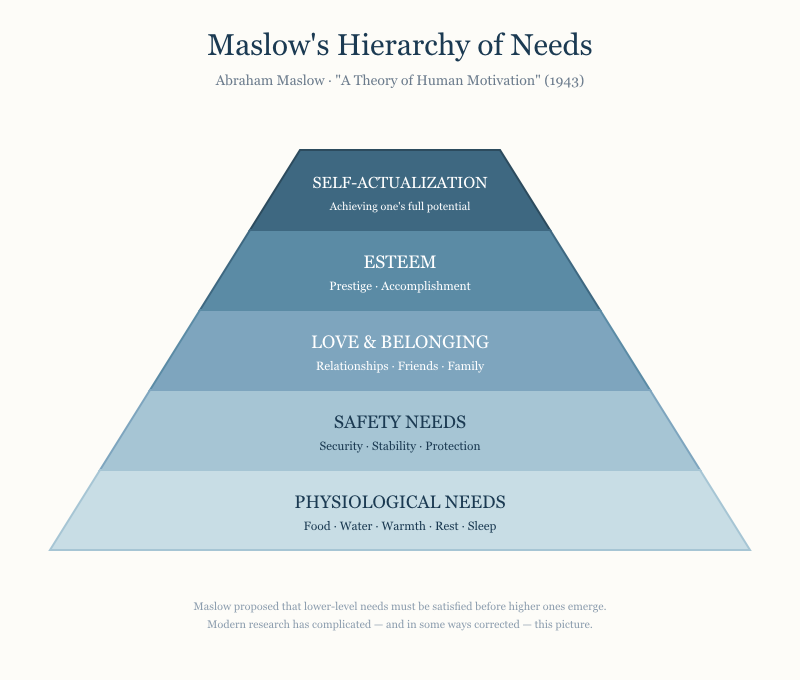
Maslow’s Hierarchy of Needs is Lacking Purpose
Maslow's hierarchy of needs is one of the most recognizable models in psychology. Physiological needs at the base, then safety, belonging, esteem, and self-actualization at the top. It's tidy. It's intuitive. It's the diagram everyone remembers from their first psychology class.
And it's missing a piece.
Look again at those five levels. Purpose isn't there. Not as a rung. Not as a stage. Not as a hidden assumption. Maslow built a theory of human motivation and left out the one ingredient that, when present, multiplies the effect of everything else.
There's also a structural problem with the pyramid itself. In 2011, Louis Tay and Ed Diener published a study using Gallup World Poll data from people across 123 countries¹, and what they found pushed back hard on the rigid-sequence idea. Human needs don't actually climb in lockstep. They run in parallel. People can experience purpose, belonging, and meaning even when their physiological and safety needs aren't fully met. And the reverse is also true — you can meet all the lower needs and still have people feel flat and disengaged if there's no meaning attached to the work.
Viktor Frankl wrote about this from inside a Nazi concentration camp. He observed that the prisoners who survived longest were not necessarily the strongest or the healthiest. They were the ones who had something to live for — a manuscript to finish, a child to find, a purpose that pulled them forward when every physical signal said stop. "He who has a why to live," Frankl wrote, quoting Nietzsche, "can bear almost any how."
That was not a metaphor. It was a clinical observation. And I've yet to find a better description of what separates the teams who hold together from the ones who don't.
What the Gallup Data Actually Shows
If you think the Frankl observation is just a mid-century curiosity, the modern data is remarkably consistent with it.
In late 2025, Gallup and Stand Together released a joint study called The Power of Purpose.² They surveyed 4,475 U.S. working adults in August and introduced a new measurement called the Work Purpose Index — a three-item measure of how strongly employees feel their daily work contributes to something important, benefits others, and provides a sense of meaning.
The findings are hard to ignore. Employees with a strong sense of purpose in their work are 5.6 times more likely to be engaged than their low-purpose peers — 50% versus 9%. They are also far less likely to burn out. Only 13% of strong-purpose workers say they feel burned out "very often" or "always," compared with 38% of those who feel low purpose at work. And when it comes to staying put, 41% of strong-purpose workers are actively job-seeking which is a lot but, it's a whopping 68% of the low-purpose group!
Daniel Pink's research in Drive pointed the same direction years ago. Pink identifies three motivators that conventional reward systems can't produce on their own: autonomy (the desire to direct your own work), mastery (the urge to get better at something that matters), and purpose (the need to connect your effort to something larger than yourself). Pink has never argued that compensation is irrelevant. He's argued that it's incomplete.
What This Looks Like in Real Life
Here's one real-world example worth celebrating. In a 34-bed adult ICU in Vancouver, Canada, a group of nurses started something called the Patient Stories Project. The idea was disarmingly simple: invite former ICU patients to return to the unit on a regular basis and share their story with the team. Tell us what you remember. Tell us what mattered.
A peer-reviewed study followed what happened to the nurses who listened.³ They reported a renewed perspective on why their work mattered. A stronger sense of team belonging. Relief from the moral distress that drives burnout. The intervention cost almost nothing. What changed wasn't the money. It was the meaning.
Rick Warren put it simply: "The only really happy people are those who have learned how to serve." That's not sentimentality. It's organizational psychology. People who see their effort connected to a purpose beyond themselves become qualitatively different teammates. They stay when staying is hard. And they bring ideas on the days when everyone else is just trying to get through.
Three Indicators Your Team Is Running on Fumes Instead of Purpose
How do you know whether your organization is purpose-driven or just purpose-branded? Here are three diagnostic questions I use with healthcare executives and faith-based leaders:
1. Can your frontline people articulate why — not what — they do? Not the mission statement on the wall. The personal, felt reason they show up on the hard days. If the answer is "because I need the paycheck" or "because it's my job," you have a meaning deficit, and no compensation strategy will fix it.
2. When pressure increases, does your team lean in or pull back? Purpose-driven teams tend to accelerate under pressure. They find a gear that wasn't visible when things were comfortable. Comfort-driven teams do the opposite — they conserve energy, protect themselves, disengage. Watch what happens in your organization on the worst day of the quarter. That behavior is your real culture.
3. Do people talk about the mission when no one is watching? Not in the all-hands meeting. Not in the annual report. In the break room. In the parking lot. In the group text after a hard shift. If the mission lives in those spaces, you have something money cannot buy. If it doesn't, the mission statement is decoration.
The Ingredient That Multiplies Everything Else
Sgt. Bailey didn't jump into that water because of overtime pay. He jumped because he had a reason bigger than his comfort.
What Maslow missed, and what the Gallup data now confirms, is that purpose is the ingredient that multiplies everything else. Take care of your people AND connect them to why the work matters, and you build an organization that holds together when the pressure rises.
That kind of motivation is not limited to disaster zones. It's available to any leader willing to do the work of connecting today's tasks to a larger story.
Maslow gave us a useful framework. He just left the most important ingredient off the pyramid. Forty years of research — from Frankl to Tay and Diener to Pink to Gallup — has been quietly filling in the piece he missed.
The question for your organization this week isn't whether you have a mission statement. It's whether your people own it.
Notes & References
[1] Tay, L., & Diener, E. (2011). Needs and subjective well-being around the world. Journal of Personality and Social Psychology, 101(2), 354–365. https://doi.org/10.1037/a0023779. Study analyzed Gallup World Poll data collected 2005–2010 across 123 countries, testing whether the needs in Maslow's hierarchy operate universally and in a fixed sequence. Finding: needs run in parallel rather than in Maslow's rigid sequential order.
[2] Gallup & Stand Together. (November 2025). The Power of Purpose. Nationally representative survey of 4,475 U.S. working adults conducted August 18–25, 2025. The study introduces the Work Purpose Index, a three-item measure of work purpose. Primary source: news.gallup.com/poll/697403/purposeful-work-boosts-engagement-few-experience.aspx
[3] Gurney, L., MacPhee, M., Howard, A. F., & Rodney, P. (2020). Exploring the relational intervention of storytelling: A qualitative study of the Patient Stories Project in a single ICU. Critical Care Explorations, 2(9), e0224. https://doi.org/10.1097/CCE.0000000000000224. Study conducted in a 34-bed adult ICU at a Canadian tertiary care teaching hospital (Vancouver) employing over 200 nurses. The Patient Stories Project is a nurse-initiated intervention in which former ICU patients return to the unit on a regular basis to share their experiences with the team. Key themes documented by the qualitative study: perspective taking, emphasizing the value in caring, providing positive closure, engendering team belonging, and building a sense of hope.
About Dan Diamond, MD
Dan Diamond, MD is a physician, international disaster responder, recipient of the President's Volunteer Service Award from President Obama, author, and speaker with more than thirty years of experience building teams under extreme pressure. He has led medical operations in the aftermath of Hurricane Katrina, the 2010 Haiti earthquake, Typhoon Yolanda in the Philippines, and numerous other large-scale disasters.
He is the author of Beyond Resilience: Trench-Tested Tools to Thrive Under Pressure, and works with healthcare organizations and faith-based nonprofits to develop leaders who perform under pressure.
Book Dan Diamond, MD for your next leadership event → dandiamondmd.com/speaking
Get the book → Beyond Resilience
Subscribe to the Trench Tested newsletter → dandiamondmd.com/subscribe