

The Diagonal Shove: How Good Leaders Quietly Burn Out Their Best People
Last week, Fortune reported that CEOs are using AI-driven layoffs as a deliberate productivity tool.¹ The thinking is simple. Scared people work harder.
Fifty years of Christina Maslach's burnout research and a week running the Medical Triage Unit at the New Orleans Convention Center after Katrina say the opposite. Fear doesn't fuel performance. It depletes it. And it does so in a sequence that's measurable, predictable, and starts months before anyone sees the symptoms.
Most leaders watch for the symptoms.
The damage starts upstream.
A 2×2 You Can Draw on a Napkin
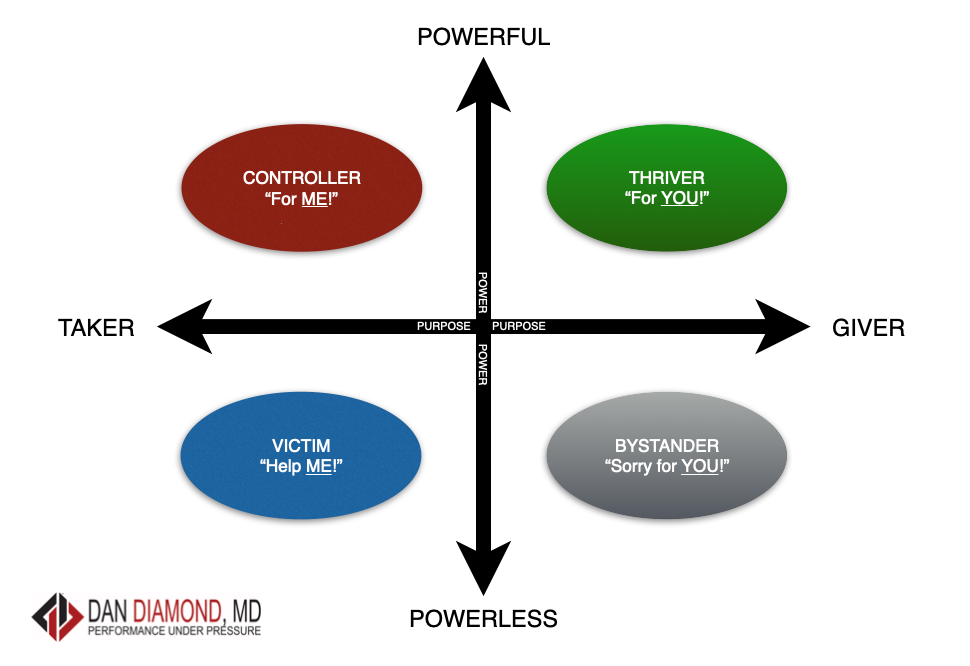
The 4 Mindsets Revealed Under Pressure
When we explore this in workshops, I draw a simple grid with two axes:
Power (top) vs. Powerless (bottom)
Giver (right) vs. Taker (left)
These aren't four types of people. They're four mindsets. Every person operates in one of them at any given moment — including you, including me, including the executive who just announced a "right-sizing initiative."
Victim (powerless taker) — looking out for self, motivated by secondary gain
Bystander (powerless giver) — wants to help, doesn't believe they can
Controller (powerful taker) — in charge, abrasive, currency is fear
Thriver (powerful giver) — builds others up, multiplies capability
The world feels uncertain. Foundations are shifting. People are afraid, and many leaders are afraid too. What's happening right now is a quiet, structural drift toward the Controller.
A Week in the Parking Lot
In September 2005, I served as Director of the Medical Triage Unit at the New Orleans Convention Center after Hurricane Katrina.
We worked out of tents in the parking lot. The 82nd Airborne provided security. Up to six helicopters were taking off and landing at any given moment, close enough that you had to lean in to hear someone speak even when they stood next to you.
Patients arrived continuously. Supplies were limited. Communication with the rest of the medical response was patchy. Decisions had to be made in seconds, by people who were exhausted, and many of those people did not technically work for me.
If I had tried to lead that operation as a Controller — barking orders, dressing people down, threatening the volunteers — the response would have collapsed inside of an hour. People could have died. Not because the volunteers were fragile. Because fear, under that kind of pressure, doesn't sharpen people. It freezes them.
What worked was the opposite.
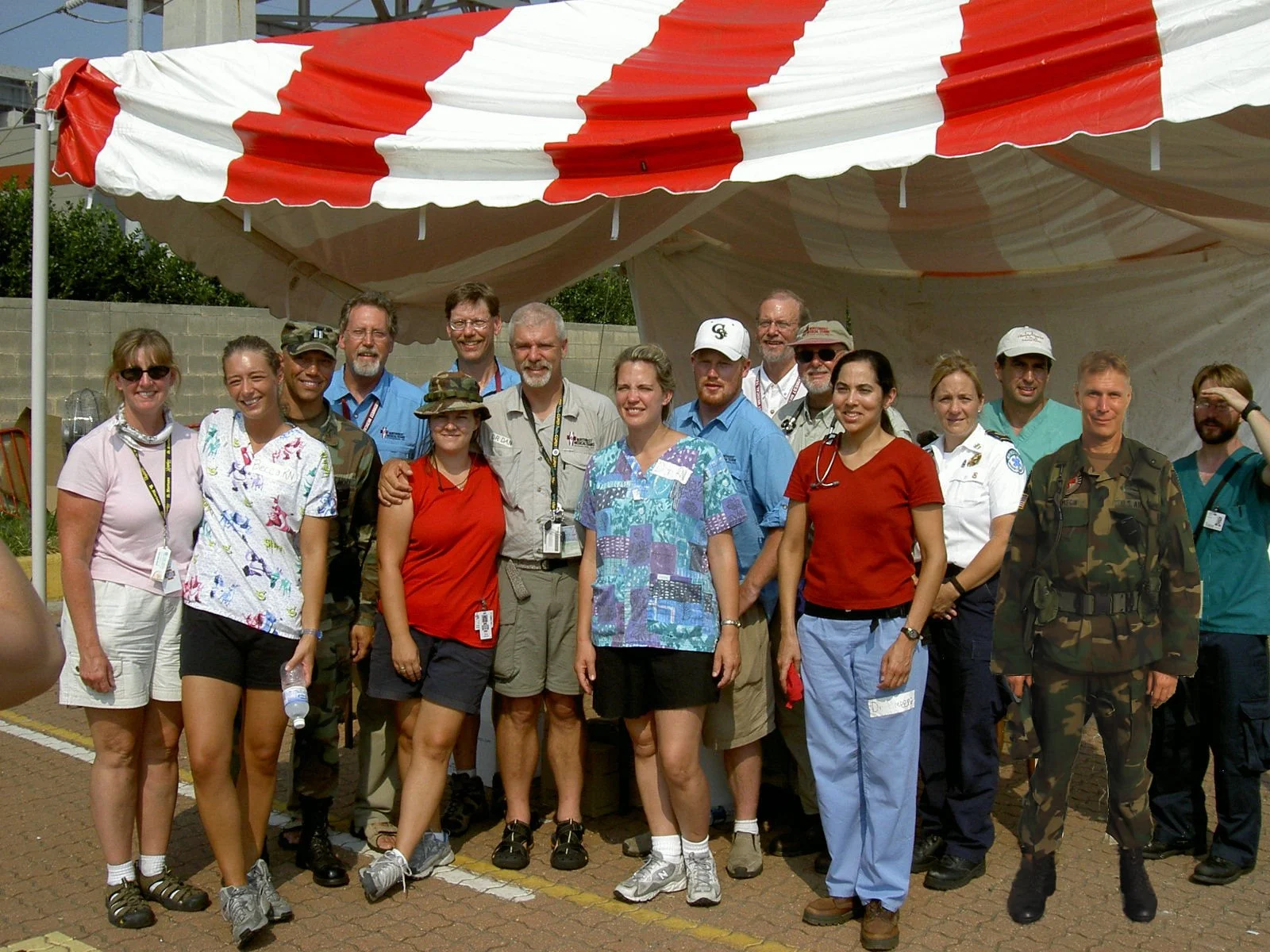
New Orleans Convention Center - Hurricane Katrina
Distributed authority. Asking instead of telling. Naming what people were already doing well, out loud, in front of the team. Trusting nurses and EMTs to make field decisions because they were the ones with eyes on the patient. Giving power away, and discovering, as I have discovered in every disaster I've responded to since, that giving power away is how you generate more of it.
I've spent the years since trying to put language to what I learned that week. The 2×2 above is part of it. What comes next is part of it too.
The Controller Looks Like a Strong Leader (At First)
Controllers are decisive. They issue ultimatums. They get described, often in glowing executive profiles, as "no-nonsense" and "results-driven."
Their currency is fear.
Sometimes the fear is overt: layoff announcements, return-to-office mandates issued as veiled threats, "AI may take your job, work harder." Sometimes it's subtle: the cold reply-all, the meeting where one person's mistake gets dissected for forty minutes, the quarterly review that feels like a hostage negotiation.
Either way, fear works. Briefly.
People scramble. Output spikes for a quarter. The Controller looks like the leader the moment demanded.
And then, somewhere between week three and month six, the actual cost arrives.
The Diagonal Shove
Here's the dynamic most leadership books never name:
When a leader operates as a Controller, the frontline gets pushed diagonally across the grid from a Thriver into the Victim mindset.
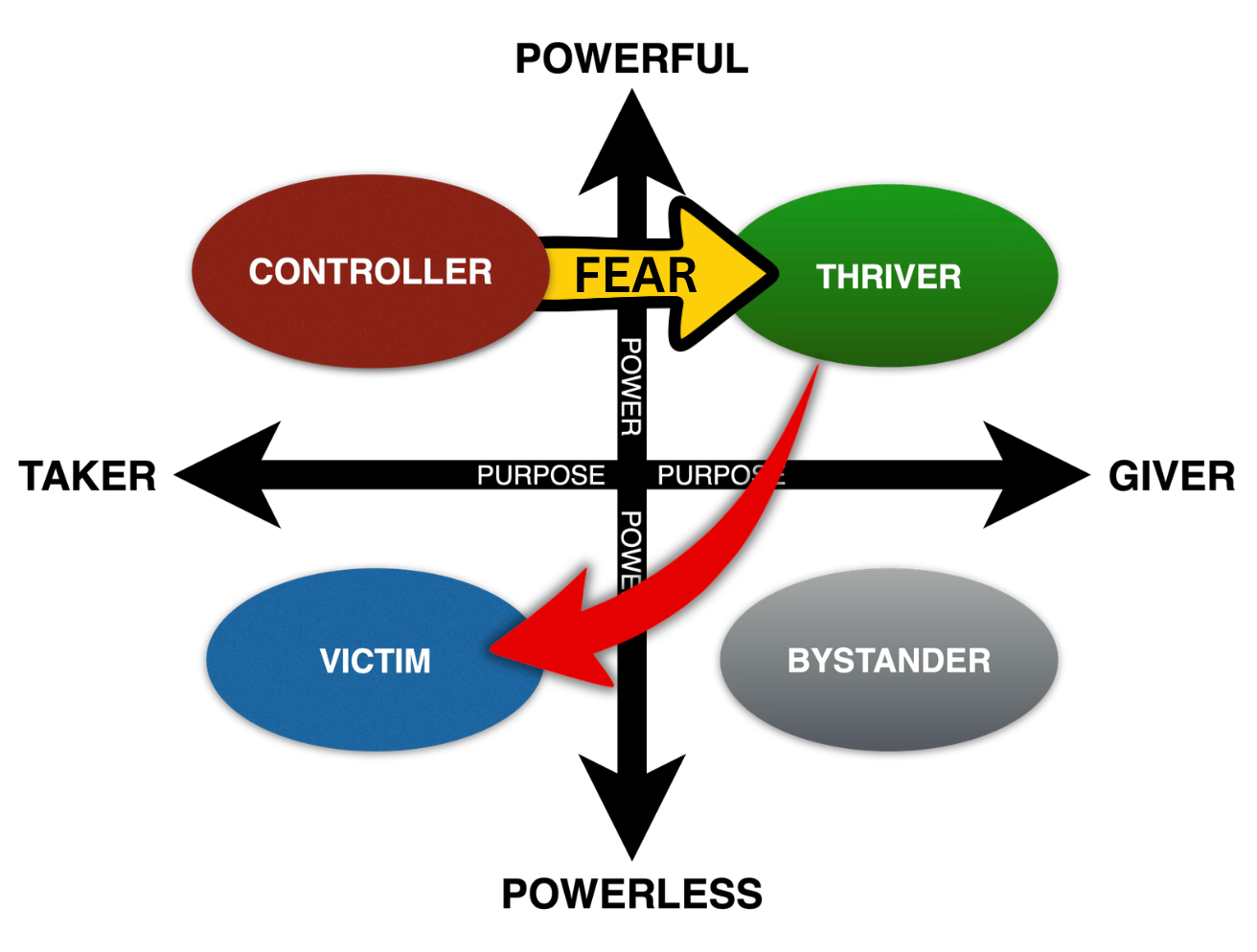
The Diagonal Shove the Dismantles the Team
Powerful giver → powerless taker.
It's not that your best people become worse people. The mindset they brought to work, the "I'm here to contribute, I can make a difference" mindset that drew them to mission-driven work in the first place, gets quietly overwritten.
What overwrites it? The signal from above. Fear generated by a Controller provokes a Victim reflex below. People who were operating as Thrivers a month ago start checking their email at 2 a.m. to see if they're still safe. They stop volunteering ideas. They start “looking out for number one”.
That's the mindset shift.
It happens weeks, sometimes months, before any of the symptoms a leader actually notices.
Maslach Measures the Fruit. The Mindset Shift Is the Root.
Christina Maslach has studied burnout since 1976. Her framework, refined over decades and laid out in The Truth About Burnout: How Organizations Cause Personal Stress and What to Do About It, identifies three measurable dimensions:²
Exhaustion — the depletion of emotional and physical resources
Cynicism — disengagement from the work and the people in it
Inefficacy — the loss of confidence in one's ability to make a difference
Her survey instruments are excellent. Hospitals, healthcare systems, and HR departments use them. They tell you, with reasonable accuracy, that someone is burning out.
Here's the catch.
By the time the Maslach Burnout Inventory shows symptoms, the mindset shift happened months earlier.
Maslach's three dimensions are the fruit. They're downstream. They're what shows up after the root has rotted.
The root is the diagonal shove from powerful giver to powerless taker.
Once you can see that, once you understand that exhaustion, cynicism, and inefficacy are not the disease but the visible end-stage of it, you start asking a different question. Not "How do we reduce burnout?" but "Who in the system is leading with fear?"
What This Means for the Boardroom This Week
Look at what's happening across American workplaces right now.
CEOs are openly using layoff fear as a productivity strategy. Return-to-office mandates are being deployed, in the words of some of the executives doing it, as "soft layoffs." The Q1 2026 tech layoff wave has produced what researchers are now calling FOBO, Fear of Becoming Obsolete, affecting roughly 40% of employees, up sharply from prior years.³
These are Controller moves at scale.
The predictable response, the response Maslach has been documenting since 1976, is already underway. Engagement scores are dropping. The healthcare workforce in particular is hemorrhaging, with two in five workers describing their jobs as unsustainable and one in four considering leaving the field entirely.⁴
Boards will look at those numbers next quarter and say, "We have a burnout problem."
They might miss the root cause: they have a Controller problem that has produced a burnout outcome.
The intervention is not another wellness app. The intervention is for the leader to pause, notice what's actually going on, and choose to show up as a Thriver, with the conviction that "I have the power to make a difference, and it's not about me."
Two Questions Before You Walk Into Your Next Meeting
If you lead anything, a department, a service line, a hospital, a church, a startup, a team of three, sit with two questions before the week begins.
One: What mindset am I operating from right now?
Not what you wish you were operating from. Not what your last 360 review said. What's the actual posture you bring into the room when the pressure is on? Powerful or powerless? Giver or taker?
Two: What mindset am I provoking in the people who report to me?
Here's the hard truth I keep coming back to, twenty years after Katrina. Every leader provokes a mindset in the people around them. Whether you intend to or not. Whether you notice it or not.
Walk into your team's space tomorrow as a Thriver, and you'll pull people toward Thriver. Walk in as a Controller, and the most committed people on your team will start the slow, invisible slide into Victim. A year from now, when you're reading the engagement survey and wondering what happened, the answer will be sitting in the chair you're reading it from.
The mindset shift that comes before burnout is real. It's measurable. It's preventable.
But not by the person burning out.
By the person above them.
By Dan Diamond, MD | Former Disaster Doc · Author · Speaker · Coach
If you lead something, the two questions above are worth ten minutes this week. If your team is already showing the symptoms, that's a different conversation. Let's talk.
Sources
Megan Leonhardt, "Fewer than 1 in 4 workers feel their job is safe. Here's why worker 'FOBO'—fear of becoming obsolete—is hurting companies," Fortune, April 23, 2026. https://fortune.com/2026/04/23/ai-anxiety-workers-job-insecurity-fobo-ceos/
Maslach, Christina, and Michael P. Leiter. The Truth About Burnout: How Organizations Cause Personal Stress and What to Do About It. San Francisco: Jossey-Bass, 1997. The three dimensions of burnout — exhaustion, cynicism, and inefficacy — are operationalized through the Maslach Burnout Inventory and detailed in this volume.
Mercer Global Talent Trends survey of 12,000 executives, HR leaders, investors, and employees, cited in Megan Leonhardt, Fortune, April 23, 2026 (see source 1). Employee concern about AI-driven job loss rose from 28% in 2024 to 40% in 2026.
Indeed, Pulse of Healthcare 2025 (survey of 924 U.S. healthcare workers across clinical and nonclinical roles), as reported in Medical Economics, April 2026. Two in five healthcare workers describe their role as unsustainable; one in four are considering leaving the field entirely. https://www.medicaleconomics.com/view/health-care-workers-say-their-jobs-feel-unsustainable-indeed-report-finds